Friday, October 3, 2014

exhibition: making home in Brooklyn

New York has long held a special allure for artist from all over the world.  But at some point in the past several years, the tectonic plates of creativity in the city shifted, and Manhattan become a suburb of Brooklyn. A current show at the Brooklyn Museum surveys the recent art from the borough made by thirty-five local artists among them two Japanese-born: Yuji Agematsu and Nobutaka Aozaki, who made Brooklyn their home.


Yuji Agematsu, who landed in the US in 1980, has spent much of his adult life collecting discarded materials on walks through New York, then archiving his finds in banker's boxes stored in his studio and, on occasion, mining his trove to create delicate, ephemeral installations. Sometimes the pickings are displayed unchanged and sometimes they are combined into new arrangements with the elegantly formalistic effect.

Nobutaka Aozaki works are likewise ephemeral. Aozaki has created a portrait station inspired by caricaturists in Times Square. Except Aozaki has replaced drawing paper with plastic smiley face bags—onto which the artist Sharpies hair, glasses, etc. The result: a bunch of photos of visitors holding up their bags vaguely in their likeness and smiling.

The exhibition runs through January 4th 2015.

Friday, May 30, 2014

into the fog

Since 1970,  Fujiko Nakaya has created numerous site-specific fog installations in cities as far-flung as Sydney, Paris, New York, Bilbao, Shanghai, Toronto, Riga and Japan. She collaborated with choreographers (Trisha Brown), musicians ( David Tudor), other artists (Bill Viola, Robert Wilson, Hiroshi Teshigawara) and architects (Diller+Scofidio, Arata Isozaki) to lend her fog to sound, music and dance.
Trisha Brown dance Company, Opal Loop/Cloud Installation #72503, 1980
Existing somewhere between 'experience-oriented' sculpture, environment and performance Fujiko Nakaya's fog works draw from radical experimentation of the 1960s. 

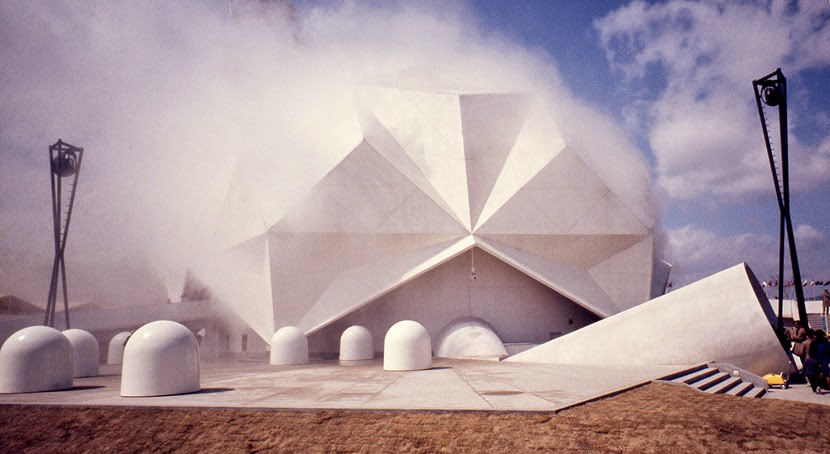
In 1968 Nakaya begun working with the seminal group Experiments in Art Technology (E.A.T), which was an association of artists and engineers founded by Bell Telephone Laboratories engineer Billy Kluver. Her first project with E.A.T. was Pepsi Pavilion for Osaka Expo'70, which unsightly dome she shrouded in the cloud of fog. It was then, when she started her forty-year long collaboration with Pasadena-based cloud physicist Thomas Mae who for her request invented a people-friendly water-generated fog.
Pepsi Pavilion for Osaka Expo, fog sculpture #47773, 1970

Her fog sculptures derive their specificity from a matrix of topographical and meteorological conditions. Nakaya's research into the weather conditions of a particular site is thus key to the development of her projects. Indeed each work bears the code number of the international weather station where it is, or was, sited.
Square Fog #47590,  The Miyagi Museum of Art, Sendai, 1981
Whole history of sculpture can be read into Nakaya's fogscapes. Her works can also be seen as challenging the tenets of minimalism, which had dominated artistic production and in particular sculpture, for the earlier part of the 1960s. Turning her back on the industrial materials of Minimalism - lead, steel, and copper - she courted ephemeral media to create semblances of natural phenomena. Fog, in Nakaya's hands, is a force of decomposition. In her own words, fog responds constantly to its own environment, revealing and concealing the features of the environment. Fog makes visible things become invisible and invisible - like wind - become visible.
Philip Johnson's Glass House, Veil, 2014
In 1953 Robert Rauschenberg (Nakaya's later friend and collaborator) erased a drawing that he requested from Willem de Kooning expressly for that purpose. Rauschenberg put the drawing in a gold leaf frame with a handwritten label that read: Erased de Kooning Drawing, Robert Rauschenberg 1953. Nakaya's fog environments share something in common with Rauschenberg's gesture. 

Saturday, March 1, 2014

exhibition: perspective in white

Norio Imai was only a high school freshman in Osaka when he saw on television Gutai Art Association members demonstrating their unconventional approach to art making. Ever since he frequented Gutai Pinacotheca events and exhibitions. In 1965 he join Gutai as its youngest member and moved from filmmaking onto exploring the fusion of photography, performance, and sculpture. He was only seventeen, when he participated in 14th Gutai Art Exhibition with one of his earliest white relief paintings.

Imai was interested in Lucio Fontana's Spatial Concept, which he knew thought art magazines and books. Fontana's monochromatic canvases with slits or punctured holes created an air of mastery. Imai was able to see some of his works in person at the exhibition held in Pinacotheca in 1964.
Around that time he recalls discovering in Kodama City, near Osaka dozens of discarded parts of speakers manufactured by Panasonic Corporation, which inspired him to manipulate canvas to make various relief paintings that would represent the proliferating sounds of an information Society. The odd-shaped forms that resulted from this mode of art making seemed to throb with restless energy, as if the objects hidden beneath Imai's swelling canvasses were to burst through the smooth, luminous surfaces of canvas.

The affinities of Imai's works with the international contemporaries raised some red flags and he was accused by his mentor Jiro Yoshihara, who was an author of Gutai's manifesto to do something no on else has ever done before, that his works were similar to those of Castellani. Even though Imai did not know Castellani's white relief paintings before then he decided to move onto experimenting with kinetic art instead.


At 16th Gutai Art Exhibition in 1965 he displayed two boxes, called White Event. Each box measured about one meter square and contained a motor, which pushed a round protrusion against a rubber cover evoking some lunar landscape or volcanic mountain. These two works as well as those from the formative stage and the further deviations from Castellani and Fontana's works are now on view at Galerie Richard Chelsea, NY.

(Adaptation of Midori Yoshimoto text: In Pursuit of White Abstractions: Imai Norio and the Global art of the 1960s)

Sunday, February 23, 2014

exhibition: Taro Award

Taro Okamoto was an artist leading his era, always challenging towards something new. In 1954, Okamoto published a book called Today’s Art subtitled Who will Make History
The Okamoto Taro Memorial Award for Contemporary Art, commonly referred to as the Taro Award, was established shortly after he passed away. It is one of Japan's most coveted art recognitions and the only one these days that actively encourages radical experimentation. 

This year the Taro Okamoto Award went to Kyun-Chome an art unit composed of two artists, Honma Eri and Nabuchi who's portfolio parallels that of Chim↑Pom in a number of ways (performances pieces staged and recorded in restricted areas around Fukushima, interactive gallery installations which temper with Japanese paradigms and cultural taboos and the central focus on a female character), which is of no surprise considering that Kyun-Chome were previous apprentices of Chim↑Pom's. 

For the 17th Taro Okamoto Contemporary Art Award exhibition they spread one-ton of white rice on the floor with the mound of red painted rice in the center, which combined resembled Japanese flag. To enter the space the visitors had to go under the do-not-enter tape and walk on rice to view video work showing the New Years's Eve of 2013 in abandoned Fukushima. Whilst everywhere else in Japan people went to their local temples to ring the bells and chase away all the past year evils, Fukushima remained silent until someone broke-into prohibited zone to toll the bell there as well. 

Saturday, February 1, 2014

exhibition: Kazuko Miyamoto


Miyamoto was primarily a painter of large-scale bichromatic multi-media canvases, works that inflected and, in some ways, undermined formal systems with modest, organic painterly elements that would satisfy the strictest dictates of orthodox minimalism.

In 1969, Kazuko Miyamoto was working in her live-in studio at 117 Hester Street when the fire alarm went off. Congregating on the street below with other artists from the building, she met her neighbor Sol Le Witt, and soon after become his assistant. For several decades, she executed his wall drawings and oversaw the production of his modular cube sculptures.

Today, the Japanese-American artist is best known for her signature post-Minimalist works. Her recent self-titled exhibition in Invisible Exports examined the beginnings of her work and featured a judicious selection from 1970s drawings as well as one of her signature installation pieces—a structure made simply of thread and nails that protrudes from the bare walls of the space.

Miyamoto (now the owner of Gallery Onetwentyeight, in Manhattan's Lower East Side) developed her signature nail and thread style of installation throughout the '70s. She continued building these site-specific sculptures throughout her career. And over time, she found herself gradually abandoning strict measurements. Her sculptures became increasingly organic. As Miyamoto once wrote of herself in a press release for her first solo exhibition in New York in 1973: "Kazuko create[s] linear system by extending string between nails on wall. These materials and lighting form an area of sensitivity and spaciousness. The most beautiful is to have nothing on the wall, the second most beautiful is to have line on it, and then the third is to break the wall."

Sunday, January 19, 2014

art in action: Eiko&Koma

38 Works (1976 - 2011) from Eiko and Koma on Vimeo.

Since 1972, Japanese-born dancers, Eiko&Koma have created a unique and riveting theatre of movement out of stillness, light and sound. Primal, intense, and powerfully moving, their pieces explore elemental themes such as birth, death, desire, struggle ,and profound connection between human and nature. Eiko&Koma studied with Kazuo Ohno in Japan, Manja Chmiel in Germany and Lucas Hoving in the Netherlands before moving to United states in 1976. Yet they do not consider themselves as dancers in any traditional sense. rather, they think of themselves as artists whose medium is movement and whose work resides in the space between dance, theatre, performance art, and sculpture. This is why throughout their careers they have presented their works outside conventional dance venues. Exactly a year ago I saw their installation The Caravan Project performed in a specially modified trailer in the garden lobby of MoMA. Now I'm reading their first comprehensive monograph published by Walker Art Center, which has been enjoying a long history with artists. The book is an extensive research into the ephemera of the artists’ forty-year career and include program notes, flyers, performative and editorial photography, video, reviews, and letters. Below a selection of few spreads from Eiko&Koma: Time Is Not Even, Space Is Not Empty.


Sunday, October 13, 2013

exhibition: rebirth


It’s been a full decade since Mariko Mori’s last New York museum show, and viewers who remember that exhibition might not even recognize the artist in “Rebirth: Recent Work by Mariko Mori,” at Japan Society. The futuristic fashion plate of Ms. Mori’s earlier photographs and videos — the artist herself, in Manga-inspired get-ups — seems to have vanished, and so has her contemporary Japanese landscape of malls, airports and business districts.

In their place are meditative, abstract sculptures and installations, strongly influenced by Buddhism, theoretical physics, and prehistoric cultures (and also, it often seems, by other contemporary artists like Hiroshi Sugimoto and James Turrell). They make up an ambitious but disappointing show, which summons big ideas and primal energies only to give them trite, New Agey forms. Continue reading

Saturday, September 21, 2013

exhibition: out of doubt

               
For this four iteration of the Mori Art Museum's comprehensive triennial of contemporary Japanese art, the institution's chief curator Mami Kataoka, is joined by guest curator from Australia and US. Together, they have selected a group of thirty participants, which (unlike in years past) also includes expatriate Japanese artist and those of Japanese decent: Ei Arakawa, Aki Sasamoto, and Simon Fujiwara to name a few. The roster is farther expanded with work by several postwar artists such as anti-art pioneer Genpei Akasegawa, reportage painter Hiroshi Nakamura, and Mono-ha artist Kishio Suga.

Kishio SugaLinked Space,  2010, wire, cement
Installation view: Gallery 604, Busan; photo: Sato Tsuyoshi
Among other figures, who utilized nonsensical painting, incomplete objects, and performance to question cultural values and disrupt rigid social programs. Seen in dialogue, the art of this international ensemble promises to demonstrate the ways in which ideologic and methodological legacies of the Japanese avant-garde have been transmitted between generations.

Mika TajimaThe Extras, 2010, wood, canvas, acrylic paint, silkscreen, mirrored aluminum, wood, paper, plexiglas, MDF, spray enamel, video monitor, formica, glass, lights; photo: Jason Mandella, Courtesy: Sculpture Center, New York
(Artforum Sep 2013 issue)

Thursday, September 12, 2013

exhibition: curated body

Eikoh Hosoe, Man and Woman #24, 1960
Eikoh Hosoe emerged in the experimental arts movement of post-war Japan. Early on in his career he abandoned the documentary style prevalent in the post-war years and produced work that breathed a sense of experimentation and freedom into photography. He developed a unique style combining photography with elements of theatre, dance, film and traditional Japanese art.
Eikoh Hosoe, Man and Woman #20, 1960
Hosoe gained recognition in the late 1950s with the series Man and Woman (1959) wielding power in their explicit exploration of the human form. Permeated by dark, obscure images of naked bodies, Man and Woman is inspired by Tatsumi Hijikata, the charismatic dancer and founder of Butoh dance movement, whom he met through his friend, the writer Yukio Mishima. Hosoe’s concerns resonated deeply with Hijikata whose performance explores themes of death and eroticism through exaggerated, and extremely slow movement, by performers covered in white body paint.
Eikoh Hosoe, Embrace #60, 1970
Produced then years later Embrace series reduce the model’s flesh to a calm abstract contemplation of body contours.  Human limbs are treated as the subjects of a still life, but there is a surprising amount of movement as well —muscles are taught, and bodies are folded and pressed against one another.

In 1974, Hosoe was selected by MoMA as one of 15 artists in the first major survey of Japanese photography outside of Japan. Images from his Man and Woman series were part of the landmark exhibition, New Japanese Photography, and are now on view once again in Miyako Yoshinaga Gallery in New York, along with the prints from Embrace series. 

Tuesday, August 27, 2013

project room: Three

               
Three (est. 2009), an anonymous artist collective from Fukushima Prefecture stayed in New York for the month of July as the first invitees to Japan Society's Summer Artist Residency Program. 

Hailing from Fukushima, the artists were direct victims of the earthquake, tsunami and nuclear fallout. In fact, their latest work “Tokyo Electric” was created for the 2nd anniversary of the earthquake. The imposing cubic structure stands over 3 meters high and is built to the same scale of the Fukushima nuclear power plant, explains the artists. It was made from 151,503 soy sauce containers – a number that happens to represent the number of displaced citizens.


Multiplicity is a common element in Three’s work. And their medium of choice – often objects that are cheaply mass-produced – is a reminder of our increasingly inorganic society and the death of the individual. Numerology is equally important element and so during the month-long stay Three created 555 works using 500 Japanese comic and anime plastic figures and 55 of their American counterparts taking cue from the number five in homage to five boroughs of New York.

Friday, August 2, 2013

collection of painted days

On Kawara studio
On Kawara is interested in time - its days, years, centuries, and eons. Each Date painting of his Today Series, the magnum opus that he begun in 1966, is a monochrome field on which is written the date of the day on which the painting was executed, in the language and according to the calendar of the country Kawara was in at the time. If he does not complete a painting by midnight, he destroys it. Some days he makes two paintings, very occasionally, he makes three, but most days he makes none.


Every painting in the series conforms to one of eight sizes, all horizontal in orientation, ranging from eight by ten inches to sixty-one by eighty-nine inches. And for every painting the artist mixes the color afresh, so that the chroma of each is unique. Tonalities in the brown-gray and blue-black range have dominated in recent years. four of five coats of acrylic are evenly applied to the canvas, creating a dense matte surface, onto which letters, numbers, and punctuation marks are then built up by hand, rather than aid of stencils. Initially he used an elongated Gill Sans typeface, later a quintessentially modernist Futura.

Each painting is stored in a handmade cardboard box with a clipping from a newspaper published in the same city and on the same day that the painting was made. (Kawara has exhibited the works both with and without the boxes.) A constant traveler, Kawara has created date paintings in over 112 cities worldwide, in the project that will end only with his death.

Thursday, July 11, 2013

art in action: sincere cappuccino

The works I like most is always the art I don't understand, those that stick in mind but eludes in every other way. This is very true of Aki Sasamoto, whose studio I visited recently.
Japanese artist who has been living in New York for over 8 years, gained attention for her multimedium installation/performances at the 2010 Whitney Biennial. More recently, her first solo exhibition in New York featured humble dollar-store materials in an expansive, ephemeral installation of sound and sculpture titled Talking in Circles in Talking. The gallery walls were transformed into a climbing-wall-cum-whiteboard, creating a backdrop for several performances.

Sasamoto placed eight stainless-steel mixing bowls on the floor around the narrow gallery. An ice pick stood upright inside each bowl, and on its sharp tip balanced a smaller steel bowl, face down. Above these precarious contraptions hung large chunks of ice suspended in loosely woven baskets made of brightly colored shoelaces. As the ice melted, the pinging of the drips on the metal was amplified through small microphones, filling the gallery with percussive, Tin Pan Alley-like sounds. Frozen inside the ice were small items, including keys, eyeglasses and wristwatches, symbolizing the "owned" nature of objects. According to Sasamoto, at the time of death, people become the objects that they are physically close to, in the way ice becomes water—a theory she articulated during her performances. continue reading
Sasamoto performances are surreal, self-contained worlds of free associations that marry distorted everyday objects with lectures and monologues, which are both melancholy and amusing. Perhaps neither the artist nor the viewer can fully comprehend what is taking place, but Sasamoto has found her own way of deferring that understanding. As she says everything we don't comprehend goes inside a pickling pot with the hope that it tastes better in the future

Monday, June 17, 2013

exhibition: Il Palazzo Enciclopedico

Earlier this month I visited Massimiliano Gioni's much anticipated The Encyclopedic Palace in Venice. To my and many others delight Gioni's elegant show blurred the distinction between outsider and professional artists presenting tantalizing roster of unknowns. Among them Shinichi Sawada born with severe autism who express himself through sculpting an expanding menagerie of clay figures in his mountaintop studio.  

All of Sawada's works - dragons, demons, totemic figures with multiple faces, and twisted, howling masks - bristle with hundreds of handmade clay spikes, which give them an intricate, ornamental beauty and a menacing look. Some seem to be inspired by ancient Japanese lore, other by Noh theatre masks or even Manga and Anime. Yet others recall the arts of African tribes but their true nature and cosmology state the inner life of the artist and may never be known.


The other Japanese artist in the show is not so unknown and since his works have been sown at last dOCUMENTA (13). Nevertheless it was good to see his riotous, multi-layered works in painting, sculpture and bookmaking in different context, which played in his favor. Responding directly to mass media and contemporary urban life, Shinro Ohtake's works feature accumulations of found materials, which manage to suggest both short burst of slapdash energy and years of considered, geologically paced buildup.
One of the most prominent and persistent facets of Ohtake's practice is his series Scrapbooks, which, since its inception in 1977, has grown into a collection of over 60 individual books, some over seven hundred pages long. These books hold mountainous collections of found materials, which the artis collages and paints to create complex compositions on each page of the book so that each of them become sculptural object.


text based on Il Palazzo Enciclopedico guidebook

Saturday, June 1, 2013

project room: Koki Tanaka

The jury of the 55th Venice Biennale, the world’s most prestigious art event, has given special mention to Koki Tanaka, the first time an artist in the Japanese pavilion has won an award since the biennale's inauguration in 1895.


In his diverse art practice spanning video, photography, site-specific installation, and interventional projects Koki Tanaka focuses on the perplexities of everyday experience, which can be funny, mundane, pathetic, and, when attention is drawn to them, beautiful. His primary medium is ideas, and his projects test the limits of what is by imagining something slightly different and asking the viewer to do the same.

The work on view in Venice, Abstract Speaking: Sharing Uncertainty and Collective Acts, features four films, in which musicians, hairdressers, potters or poets are asked to reorient their typical methods of working. And so respectively the video focuses on five piano  players playing the same instrument simultaneously, several hairdressers who cut the hair of a single model, multiply potter forming a single piece of pottery and five poets writing the single poem.

The jury explained that they decided to give special mention to a Japanese artist for the poignant reflection on issues of collaboration and failure in the aftermath of the devastating earthquake and tsunami of March 2011.

Given the impending focus on the artist, this seems like a fine time to review Tanaka's previous works.

Since 2001, the work of Koki Tanaka has taken shape primarily as videos and installations that explore the relationship between objects and actions. His videos record simple gestures performed with everyday items—a knife cutting vegetables, beer poured into a glass, the opening of an umbrella—in which seemingly “nothing happens.” Yet, through their repetitive composition and heightened attention to detail, Tanaka’s videos compel us to take notice of the mundane phenomena of daily existence. Latent patterns and geometric forms emerge out of actions, and otherwise ordinary objects are transformed, providing an epiphany of sorts from moments of everyday life.

Top: Fly me to the moon, 2001, video. Bottom: Everything is Everything, 2006, video 
The culmination of this investigation into simple actions with ordinary objects takes shape as the eight-channel video installation, Everything Is Everything (2006).

First exhibited at the 2006 Taipei Biennial, this work involves the artist and two assistants recording their interactions and interventions with readily available items, including hangers, cups, towels, an air mattress and toilet paper, all found around the city of Taipei.


Over the course of eight days, the physical properties of these objects are tested (a metal hanger is stretched to its breaking point) or their uses expanded (a level placed on two table legs becomes an impromptu hurdle). At times these actions verge on the absurd , while other moments are more serene and contemplative. Tanaka experimented with each item multiple times both indoors and outdoors, and their exploits were compiled into eight distinct video. Tanaka’s tightly cropped framing of each scene often features the performers from the neck down or removes them from the shot altogether, thus focusing the viewer’s attention on the objects and the simple, repetitive acts being performed. In Taipei, the videos were displayed on eight monitors placed on the floor, along with the household items used in their making. Both monitors and objects were purposely strewn around the room, creating an intentionally chaotic installation reminiscent of a Robert Morris scatter piece.  

The repetitive nature of the actions in Everything is Everything, combined with the use of inexpensive, mass-produced materials, highlights an affinity Tanaka’s videos share with the logic of Minimalist sculpture and process art of the 1960s. as well as to the legacies of Mono-ha and Arte Povera.

Top and BottomApproach to an Old House, 2008, video
Testing the physical properties of items and inventing new ways to rethink their intended functions also gave shape to Tanaka’s next project, Physical Test (2007–08), which consists of hundreds of colorful household items placed on tabletops or hung on the wall, which have been combined with one another in unlikely ways. Beginning with the videos Approach to an Old House (2008), on through Simple Gesture and Temporary Sculpture (2008), Walk Through, test nos. 1–2 (2009), and culminating with Walking Through (2009), Tanaka’s actions become increasingly aggressive and unpredictable.
Scenes in Approach to an Old House include the artist—who was given free rein to make installations in an abandoned house in Seoul—violently tearing down curtains and cutting a string that unleashes a series of suspended beer-bottle crates that come crashing down with a deafening noise. 

In 2009, Tanaka received a three-year grant from the Japanese Agency for Cultural Affairs (Bunkacho) to move to Los Angeles, where he currently resides.

Top: A Piano Played by Five Pianists at Once (first attempt), 2012, HD video; Bottom: A Haircut by 9 Hairdressers at Once (second attempt), 2010, HD video
Since leaving Japan, Tanaka’s work has become increasingly collaborative, with a marked shift away from his material investigation of everyday objects. Instead of performing actions himself, these collaborative works focus on documenting multiple participants in their attempt to complete a given task. The artist relinquishes his role as an active participant and assumes the role of bystander to a situation of his own making.

The first collaborative work, A Haircut by 9 Hairdressers at Once (second attempt) (2010), takes place at a hair salon in San Francisco where a group of hairdressers attempt to give the model a haircut by committee and is one of the video works for the Venice Pavilion.

This approach represents an alternative but related track of the artist’s object-oriented work in which experimenting with ordinary objects in unlikely ways offers a possible escape from our everyday routine. In his collaborative works, the tables are turned, with Tanaka asking his participants to collectively navigate tasks that in and of themselves are out of the ordinary. Continue reading.

Interview with the artist.

Wednesday, May 1, 2013

art in action: Paris&Wizard


I've been posting about Ei Arakawa quite a lot already. Here is the video of his recent commission for MoMA that took place in conjunction with the exhibition Tokyo 1955-1970: A new avant-garde in which he examines pivotal story lines of early Japanese video art in the 1970s and interprets them into musical form. Paris & Wizard is based in part on particular relationships between MoMA curator Barbara London and video artists around Japan, highlights creative curiosities about new media, and the personal ties that enabled the export of this new Japanese scene into North American and European contexts.

The links below active until the end of May. Password Wizard

Part 1 (10:13)
Part 2 (9:35)
Part 3 (13:21)
Part 4 (11:49)